
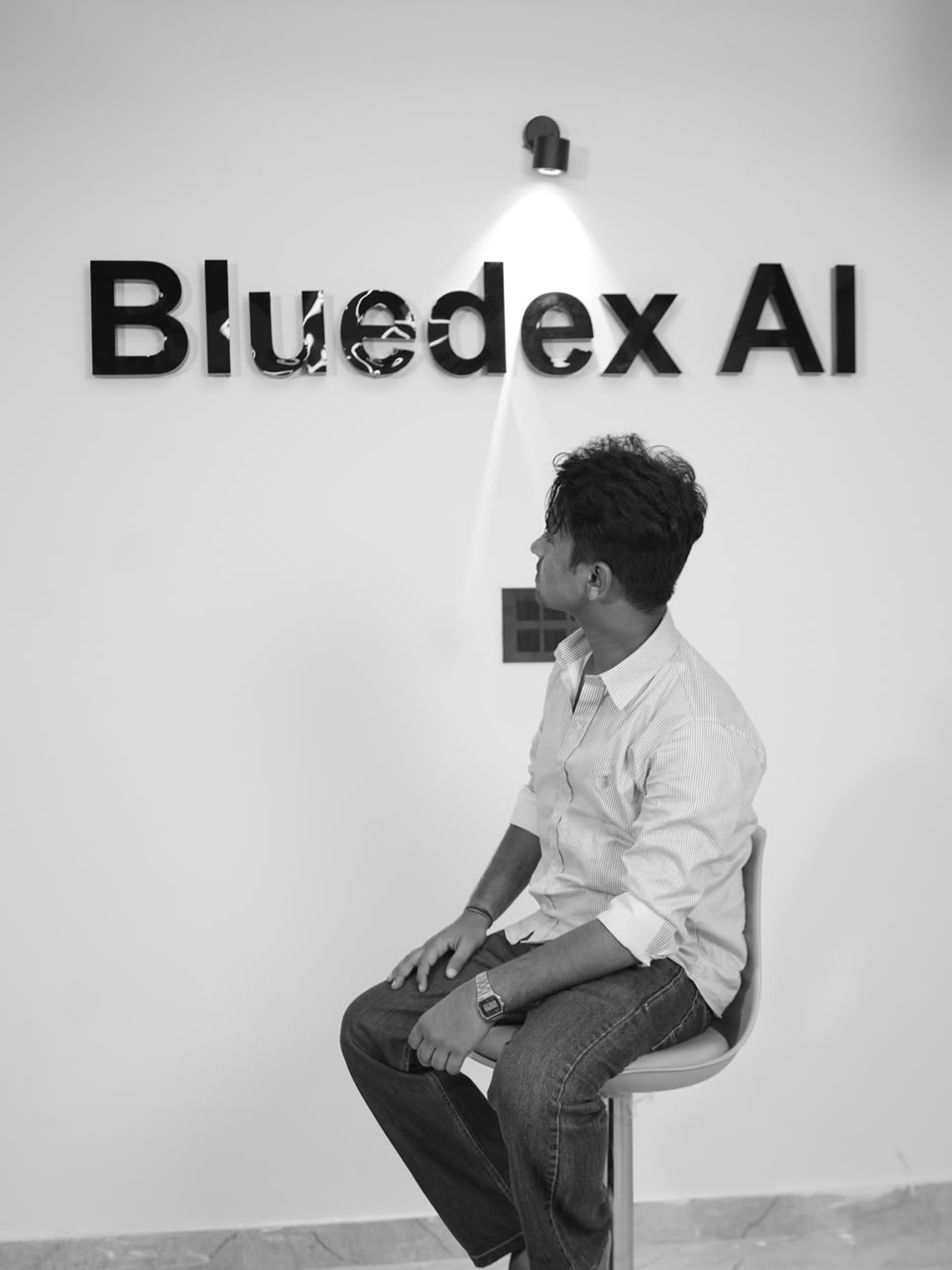
Two photographs can sometimes explain a startup’s journey better than a long presentation.
In the case of BLUEDEX, one image reflects its early days — a modest room, a small team and an operation still taking shape. The second presents a very different picture: a larger workspace, more than 50 team members, evolved systems and a startup now looking towards technology and artificial intelligence as the next stage of its growth.
The contrast is significant, but BLUEDEX’s journey has not been defined by one dramatic breakthrough. Instead, it has been built through a series of small operational improvements, product changes, difficult phases and steady expansion.
Founded in 2023, BLUEDEX entered the legal and compliance space with the aim of making services such as registrations, licences, taxation and business compliance more accessible to entrepreneurs and small businesses.
In the beginning, the setup was limited.
A handful of people managed customer conversations, documentation, regulatory applications and day-to-day operations from a relatively small space. Roles were not always clearly divided. As is common in young startups, employees often handled responsibilities beyond their formal designations.
Those early limitations eventually became part of the startup’s learning process.
A Problem Hidden in Everyday Business Operations
For a small entrepreneur, compliance can often become one of the least visible but most time-consuming parts of running a business.
A restaurant, cloud kitchen, retailer or early-stage startup may have to deal with food licences, tax registrations, trademarks, business registrations and several other statutory requirements.
Large organisations typically have dedicated legal and compliance departments. Small businesses often depend on individual consultants, fragmented service providers or their own understanding of government processes.
BLUEDEX saw an opportunity in that gap.
The initial objective was relatively straightforward: simplify access to legal, tax and compliance services.
Over time, however, the startup began to see the larger problem.
Many compliance workflows involve recurring documentation, similar customer questions, repetitive internal tasks and large amounts of manual coordination. The more cases the team handled, the more visible these patterns became.
That operational experience gradually pushed BLUEDEX towards a technology-led approach.
Products That Evolved With the Business
BLUEDEX’s earlier product and operational environment was considerably simpler than what exists today.
The first systems were built primarily to solve immediate problems. As customer volumes increased, those systems needed to change.
Repeated customer queries helped the team identify where users needed clearer communication. Documentation requirements showed which processes could be standardised. Internal bottlenecks revealed areas where automation could reduce repetitive work.
In many ways, the startup’s product evolution followed its own growth curve.
Instead of designing technology in isolation and then looking for use cases, much of BLUEDEX’s product thinking appears to have emerged from problems already being faced by its teams.
That distinction has now become particularly relevant as the startup increases its focus on Artificial Intelligence and automation.
BLUEDEX is exploring the use of AI across areas such as document handling, customer requirement identification, workflow management and repetitive operational tasks.
The idea is not necessarily to remove people from legal or compliance services. Rather, the objective is to use technology to handle routine work while allowing professionals to focus on cases that require judgement and intervention.
From a Handful of People to 50+
The most visible part of BLUEDEX’s transformation is its team.
From an early setup with only a few people, the startup has expanded to **more than 50 team members**, working across areas including sales, operations, licensing, customer support, management and technology.
Several people who joined during the startup’s earlier stages have also grown alongside it, taking on wider responsibilities as the organisation expanded.
This has influenced the internal culture.
Unlike businesses where roles are fixed from the beginning, BLUEDEX’s early-stage environment required employees to learn quickly, take ownership and often work across functions.
That culture was shaped as much by difficult phases as by successful ones.
Regulatory queries, customer escalations, operational pressure, hiring challenges and processes that needed to be rebuilt all became part of the startup’s development.
The newer office may look very different from the early setup, but much of the internal identity still appears connected to those first years.
₹4 Crore ARR and a ₹7 Crore Valuation
BLUEDEX says it has now reached an **annual recurring revenue of approximately ₹4 crore**, while its estimated valuation stands at around **₹7 crore**.
For a startup that began from a small room, the figures represent a notable increase in scale.
But the larger question is what comes next.
If BLUEDEX remains primarily a services business, its growth will continue to depend heavily on people and operations. The more ambitious opportunity lies in converting years of compliance experience into technology capable of supporting a much larger number of businesses.
This is where its LegalTech and AI strategy becomes important.
The startup’s long-term direction appears to be moving beyond individual registrations and licences towards a broader platform through which businesses can manage multiple compliance requirements in a more structured way.
Two Images, One Startup in Transition
Viewed together, BLUEDEX’s older and newer photographs represent more than a physical transformation.
They document the transition from a small operation to a 50+ member startup, from basic internal systems to more developed products, and from primarily manual workflows to an increasing emphasis on AI and automation.
The team is larger. The office has changed. Revenue has grown. The technology is evolving.
But perhaps the most important part of the story is the connection between where BLUEDEX started and what it is now trying to build.
The startup experienced many of the same constraints faced by the small businesses it serves — limited resources, growing operational complexity and the need to do more with fewer people.
Now, it is attempting to turn those lessons into technology.
Whether BLUEDEX can successfully make that transition will shape its next phase. But the two photographs already capture something significant: a startup that began with a few people in one room and has steadily built the team, systems and ambition required to think much bigger.
More Stories
Behind Every Design: How Decor Chronicle Curates 2,500+ Lighting & Décor Pieces from Global Markets
From Early Digital Printing Imports to Pan-India Distribution: How Manish Aggarwal Built Mono Sign Systems Over Three Decades
Kwala Intel Enters the Market, Betting It Can Help Retail Traders Stop Flying Blind